The following Olympic memes were circulated during the 15 days of competition, many of which were a play-by-play account during the events. The significance of which exhibits the reach of contemporary digital media, in particular social media, and the power of digital immediacy and media convergence in general. Furthermore, it also demonstrates the spreadability of memes, in which particular themes that gain popularity can be imitated and reproduced to express a host of different messages. This diffusion of information is interesting because the more successful memes are not often useful or even accurate, but they are timely, and the messages reflect feelings that readers can identify with. For example, people are able to identify with Olympic themed memes through imagery or captions concerning the event, and due to the spread and mutation of these macro images, Olympic memes have also touched on cultural issues such as obesity, due to the event being sponsored by McDonald's and advocating safe sex practices for youths, inspired by medal winning teenage gymnasts being seen as "teen role models, not teen mums". Less serious connotations include taking body contact imagery from Olympic events and noting it as being a "better love story" than Twilight.
Because, an even plane of information is accessible to all members of society through digital media, it has ushered an entirely new way in which people communicate. Just like memes are created as a result of one's response to a situation or a circumstance, memes can also only mutate through a response system. And due to the mechanisms of digital technology, memes are now commonly conceived of as an extremely contagious and often very humorous part of internet culture that can sometimes generate enough hype to break into mainstream contemporary culture. This cultural crossover is also evident with themes that originated from the sport of basketball to the even more mainstream identity of the Olympic games. For instance, there have been a number of "more rings then lebron" and "lebron's fault memes", using images from the Olympics.
So far throughout this blog, I've analysed basketball memes in terms of information and social relationships to diverse the types of memes that exist on the internet and how networked digital media has played a role in blurring the traditional distinctions between producer and audience, and also in spreading and reproducing memes very effectively. And to this point, I've emphasised the notion that memes are used as a form of expression by fans, whether it is to exhibit their passion for basketball or their frustrations with various aspects of the sport. The most popular memes mutate from mass spreading, reworking, reaction and attention. Burgess and Green (2009, 68) in their study of YouTube videos found that people tend to respond more to user-created content and such videos tend to dominate the "most responded" and "most discussed" categories of the website. These videos also tend to be the most spread, with their themes becoming templates for replication and imitation. Thus, it can also be argued that the prominence of memes can be partly attributed to the "attention economy". Davenport and Beck (2001, 20) writes, "Attention is focused mental engagement on a particular item of information. Items come into our awareness, we attend to a particular item, and then we decide whether to act. In the digital environment, attention is perhaps the most valuable commodity. For instance, attention can be directly linked to mimesis on YouTube- the number of variations spawned by a certain video, image or even just an idea is an example of attention and in turn the videos itself draws attention, in a reciprocal process. While content created by amateurs is not guaranteed attention, in fact some generate no more then a few views, attention however, can be accumulated through mimetic activity (Shifman 2011, 199).
Consequently, trends are formed and adopted. That is, there are websites associating with reporting on the latest trends with what is considered "cool" (e.g. boingoing.net, slashdot.com, getwhitit.com, reddit.com). These spaces provide readers with the latest on what is "cool" from technology to fashion, and are seen as worth following and participating in, either as contributors or readers. The same logic applies to memes in which it is considered cool to create new memes and even cooler if the meme becomes successful (Knobel 2006, 416). Examples of popular memes include the "Hitler meme", "All your base are belong to us" and "Lolcats". For the most part, these memes are often akin to inside jokes between friends and outsiders will likely have difficult in seeing the humour in or point in a lot of memes. However when a particular graphic or a video draws considerable attention either through its high rating, high voting scores or being featured among popular websites, the meme becomes successful and it is then considered cool to spread and imitate. For instance, in the world of basketball, it has become a common trend for fans to create memes featuring basketball player Brian Scalabrine. Unlike superstars Lebron James and Kobe Bryant, Scalabrine, who has spent his entire career as a sparingly used reserve, has become a cult hero among basketball fans. Scalabrine memes epitomises the logic of participatory culture and the attention economy. Memes concerning him begun spawning on popular meme sharing websites and basketball fan communities on discussion forums and social networks, setting a trend that it is in fact "cool" to support the unknown "hero", to the point where individuals not familiar with basketball may mistake him to be one of the game's marquee players through the many memes associated with him. This trend would manifest to YouTube shows dedicated to him and to influence live basketball matches with fan signs and chants showing support for Scalabrine, thus exhibiting the influence of spread through digital media.
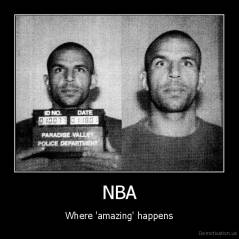
From 2007 - 2009 the NBA ran a series of advertisements featuring still images set to Carly Comando's song "Everyday" or Kanye West's "Amazing" with the catch phrase "Where Amazing Happens". Since then the ads have become popular with fans during the NBA season and on the internet with people parodying them. Earlier incarnations of this meme made fun of the league's crooked referees, ballooned salaries and player off-court discretions. While some memes are global, others are more culture specific, shaping collective actions and mindsets (Knobel and Lankshear, 2007). Later imitations of this meme including blending the theme to other sports, social activities (e.g video games) as well as showcasing what is amazing in one's own life, whether it is serious or comical.
Much like the popular "Hitler meme", where video clips of Hitler from the 2004 German film "Downfall" are used to spawn a wave of memes juxtaposing Hitler's rage with a stream of contemporary issues, the comic device for "Where Amazing Happens" is simple: new captions, images or footage are inserted with the image of the NBA logo and the phrase "Where Amazing Happens" or in the case of a video, the montage is set to the tune of "Everyday".
The series of "Where Amazing Happens" spoofs illustrates the fundamental attribute of contemporary popular culture, such as the representation system of simulacra and pastiche (Jameson 1991) in which core images such as a catch phrase, song, video clip or a photograph is replicated repeatedly. Additionally, the constant re-assembling of texts manifesting in new forms of expression, problem solving, circulation and affiliation by individuals reflect what Jenkins (2007) conceptualises as participatory culture. Fundamental to participatory culture is reworking content and sharing it in mash-ups, remixes, parodies among other actions of expression.
As mentioned in previous postings, the "most viewed" category on meme and video sharing sites is a key indicator of popularity of one's work. However, they also serve as key indicators to not only how many people viewed a meme or video but also how many individuals chose to do something with it (Burgess and Green 2009). This distinction is crucial as it epitomises the difference between the way mass media has traditionally been studied and how media can be evaluated in the digital environment where user participation is emphasised. For instance, the "Where Amazing Happens" memes originated back to a 2007 article written by Bill Simmons on espn.com in which he described a conversation with his friend about how to make a parody of the ad, Simmons shared his step-by-step ideas with his readers and since then his notes have been used as a template for parodies of the ad. These user created texts, whether it is a video or a graphic are simple in format and tend to lack the aesthetics of a professional production. Simmons' criteria is as follows-
"Where crooked referees happen."
"Where stealing money happens."
"Where paying spectators getting punched happens."
"Where a truck party happens."
Where white guys who think they're black happens."
"Where referees deciding a championship happens."
"Where quitting on your team happens."
"Where Amazing Happens."
In this sense, it may be argued that "amateur" texts translate into "good" memes (Shifman 2011). For instance, the "Where Amazing Happens" creations tend to have common features such as — focus on ordinary individuals, one's or someone else's personal shortcomings, humour, simplicity and repetitiveness. This is a distinct contrast and perhaps defiant to carefully crafted corporate content (Shifman 2011). This notion coincides with Jenkins (2009) argument that textual gaps enhance the "spreadability" of content. He argues that since the contemporary media environment heavily encourages user-involvement, the incompleteness and "amateurishness" of texts entices users into further dialogue such as fill in the gaps, address the creations or disagree with the creators, thus contributing to the spread of the meme.
Original videos
Parodies (Bill Simmons template)
Video titled "Bill Simmons Omissions" focusing on aspects of the game Simmons did not touch upon in his template.
Like
the meme community, the activities of
online video-sharing communities like YouTube blur the distinction between
producer and audience. Similar toquickmemesandknowyourmemes,YouTubeuse a rating system (like or
dislike) to guide visitors towards popular
videos. Culturally significant videos will also rise above others
based on the number of views. Burgess (2008, 101) writes that internet memes in
contemporary culture is a "faddish joke or practice" that becomes
widely imitated and reproduced. When a video is spread, replicated and mutated
"virally",its reproducibility
seems to guide its cultural value. That is, a work’s reception has become
a part of its reproducibility. In this understanding, like memes, viral
videos online are spread and mutated via distribution networks in ways
that media producers cannot control. Speaking on the cultural relevance of
memes, Lolcat creator Ben Huh (2010) believes memes are "more relevant
than most of what’s on television...just as the sitcom or the 30-minute news
broadcast or the soap opera from radio were the hallmark of how a certain
generation understood entertainment and culture". For instance, the
"Hitler reacts" videos or "the Hitler meme", involves a
dramatic scene from the 2004 film "Downfall" in which Hitler realises
his imminent defeat during World War II and begins screaming at his
subordinates. The film is in German and the videos are remixed so that instead
of the fall of the Third Reich, Hitler is reacting angrily to matters like the
weak real estate market or the vuvuzela controversy from the football World
Cup. Individually, these videos has little influence but
collectively, in their thousands and their millions of viewers, these videos
signify the variety and versatility in how people express themselves in the
digital world.
Basketball videos are remixed with a similar approach, to convey
personal opinions and ideas. For example, in recent years, there has been a
popular trend for basketball fans to remix video clips from two particular Nike
advertisements: "Rise" featuring Michael Jordan and "What Should I Do"
featuring Lebron James. The original ads document Jordan and James' dedication
to becoming elite athletes. Fan mash-ups of the advertisements have been
reproduced to "Michael Jordan responds to Lebron" and "Kobe
Bryant responds to Lebron James" which conveys the perception of Jordan
and Bryant as superior athletes citing James's fragility under big match
situations. Remixes have also included "Lebron James- What should I
do" which is a spoof video of the ad, made by disgruntled Cleveland
Cavaliers fans, the team James left to join the Miami Heat. The same ads have
also been remixed with gameplay from video games such as NBA2K and Call of Duty, and comically parodied with other sports television personalities to athletes from the NFL and UFC.
Like
memes, the "How quickly they forget" videos maintain a core framework
of the video title and the song "Serenata Immortale" as the theme.
The videos compare the on-court accomplishments of Michael Jordan
with contemporary stars such as Kobe Bryant and Lebron James.
The
dynamics of memes and viral videos can be understood as involving the spread of
replicable ideas through the processes of creativity, among individuals and
communities connected by social networks (Burgess 2008, 110). Much academic
focus is directed at the boundaries between old and new mass-media and the more
egalitarian tone that is taking shape online. The notion of advocating for certain beliefs that go against the
commercial grain of media producers or converting one's misfortunes into
hilarious entertainment for millions of viewers can be as equally important in
revealing a truth about the emerging trends in a digital age where the
producers and administrators alike do not have full control. In some cases,
expressions conveyed through memes or viral videos extend beyond the pleasure
of laughter but satirical, sarcastic, expression, intentional or otherwise
also jolts the viewer to confront other questions like, "what am I looking
at?", "what am I laughing at?" or "do I agree with this
message?" According to Walker (2010) in his New York Times article
concerning the cultural influence of memes, he writes "This is
what egalitarian cultural production really looks like, this is what
having unbounded spaces really entails, this is what anybody-can-be-famous
means...the real point is that to pretend otherwise isn’t denying the Internet
— it’s denying reality".
The current
internet meme trend, hosted predominantly by websites such asquickmemeandknowyourmemeandwhatdoumeme provides
a typical example of how mass reproduction functions in the virtual
environment. Typically, an individual meme consists of a recycled image
accompanied by a comic caption. These images may feature
well-known cultural figures like Willy Wonka from Charlie and the
Chocolate Factory, Philip J. Fry from Futurama, Ned Stark from Game of Thrones
or The Most Interesting Man in the World from Dos Equis beer advertisements.
The images may also represent newly invented characters such as the socially
awkward penguin, the paranoid parrot, scum bag Steve or bad luck Brian, to name
a few. Memes can be reproduced by any member of the public according to the
prescribed theme, for instance memes using The Most Interesting Man's image
features the trademark phrase structure, "I don't always....but when I
do...."). Since the captions are created anonymously by the viewing
public, the line between producer and audience becomes non-existent. Memes
evolves like a life form with captions behaving like genetic traits, spreading
to influence individual thought processes (Dawkins 1976). Internet memes thus
are ideas or concepts spreading and evolving over the internet, by chance,
through commentary, forwarding, search, or other communicative means
online (Wagner and Jiang 2012, 185). Without the momentum gained by sharing, a meme has little cultural relevance. On websites like quickmeme and knowyourmeme, users are guided towards the most popular memes, thus they are more likely to be reproduced and shared on Facebook streams, Twitter feeds and other social media websites. And when a meme explodes into popularity, its reproducibility appear to guide its cultural value, thus a work’s reception has become a part of its reproducibility. As a result, consensus are often formed which at times contradict against the commercial imperatives of administrators and producers alike. For instance, as exhibited in a previous post of this blog, many fans through memes, conveyed their views of Kobe Byrant as a selfish player, often disregarding his achievements in the sport, therefore forming a consensual view which contradicts against his official star image. Another example is the cult-like following Brian Scalabrine has attracted as a result of fan generated memes. Despite his perceived lack of basketball skills and playing time on the court, Scalabrine has become the inspiration of meme creations showing support for him that has transcended into positive fan responses during his basketball games.
What makes
memes generative is how the activity of meme creation has been adopted by
various participatory cultures. Popular cultural mages or phrases are
used by fans to create extended discussions concerning a variety of cultural
topics. A meme template featuring a stock image can be used as a crossover to
convey messages regarding other cultures and vice versa. This notion was shown
in previous posts regarding NBA commissioner David
Stern http://memesnba23.blogspot.com.au/2012/07/fan-displeasure-through-memes.html
and socio-cultural issues being expressed through memes featuring basketball
stars http://memesnba23.blogspot.com.au/2012/07/socio-cultural-issues-through-memes.html
. The memes below show how singular images are used to generate a host of
discussion topics, many of which are paradoxical to the image's origin industry
(e.g. using images from movies or television programs to generate conversations
about politics and sports...etc.)