Showing posts with label olympics. Show all posts

Monday, 27 August 2012

McKayla is not impressed


American gymnast McKayla Maroney was favoured to win the gold medal in the women's vault competition at the 2012 Olympics. Unfortunately Maroney's fall in her second attempt would mean the best result she could achieve was a silver medal. During the medal ceremony, Maroney clearly disappointed by her fall, stood on the podium with her arms crossed matched by the look of disappoint on her face. Soon after, the image of Maroney's disappointed face was turned into a meme by online comedians and sports fans alike. Known as "McKayla is not impressed", Maroney's face has graced historical cultural images such as the Mars rover landing, The Leaning Tower of Piza and the Taj Mahal, to name a few. The meme has spread like wildfire, going viral almost instantly after the medal presentations. And in typical meme behaviour, Maroney's image is imposed with text or photoshopped into a comical scenario, beyond the sport of gymnastics.

Of course, this viral image has also found its influence on the world of basketball fandom, where Maroney's facial expression has been incorporated into current basketball events or existing memes


Friday, 17 August 2012

Pizza Rolls

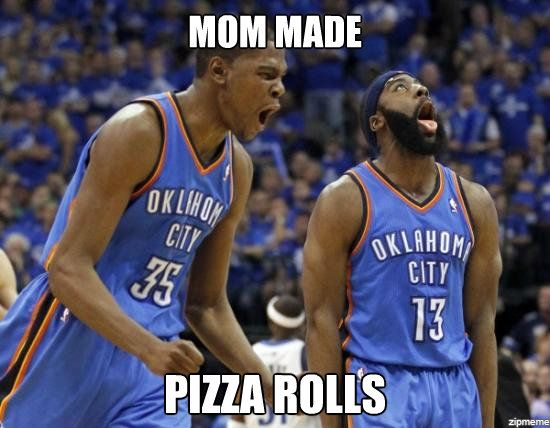
The "pizza roll" memes are a perfectly example of generativity on the internet. The origins of the meme are based on the simple premise that the members of the Oklahoma City Thunder basketball team are mostly young players. There is no direct connection between the Thunder and pizza rolls other then the simple fact that the Thunder are a young team and pizza rolls are predominately marketed toward young children. An alternative interpretation of the meme is based on the notion that the team's star Kevin Durant is perceived as a "mama's boy" because she attends all of the Thunder's home games, thus some of the memes carry the caption "mom made pizza rolls". The concept has spread and mutated into memes using images from the Olympics, baseball, volleyball, the Jewish holocaust, as well as incorporating images of politicians Barack Obama, Herman Cain and Martin Luther King, and singer Katy Perry.


Monday, 13 August 2012

Olympic memes + more Lebron's fault

The following Olympic memes were circulated during the 15 days of competition, many of which were a play-by-play account during the events. The significance of which exhibits the reach of contemporary digital media, in particular social media, and the power of digital immediacy and media convergence in general. Furthermore, it also demonstrates the spreadability of memes, in which particular themes that gain popularity can be imitated and reproduced to express a host of different messages. This diffusion of information is interesting because the more successful memes are not often useful or even accurate, but they are timely, and the messages reflect feelings that readers can identify with. For example, people are able to identify with Olympic themed memes through imagery or captions concerning the event, and due to the spread and mutation of these macro images, Olympic memes have also touched on cultural issues such as obesity, due to the event being sponsored by McDonald's and advocating safe sex practices for youths, inspired by medal winning teenage gymnasts being seen as "teen role models, not teen mums". Less serious connotations include taking body contact imagery from Olympic events and noting it as being a "better love story" than Twilight.


Because, an even plane of information is accessible to all members of society through digital media, it has ushered an entirely new way in which people communicate. Just like memes are created as a result of one's response to a situation or a circumstance, memes can also only mutate through a response system. And due to the mechanisms of digital technology, memes are now commonly conceived of as an extremely contagious and often very humorous part of internet culture that can sometimes generate enough hype to break into mainstream contemporary culture. This cultural crossover is also evident with themes that originated from the sport of basketball to the even more mainstream identity of the Olympic games. For instance, there have been a number of "more rings then lebron" and "lebron's fault memes", using images from the Olympics.


Friday, 3 August 2012

More Lebron's fault, Olympic memes


The invitation to remix is reminiscent of classical forms of story telling. For example, music is one form of source text that is continually reinvented through covers, parodies and remixes. Like songs, memes gained popularity due to their open invitation to participate, consuming, collecting, remixing and sharing. Using "lolcats" as an example, it is formed simplistically with minimal creativity and according to Clay Shirky (2010, 18), "the average lolcat image has the social value of a whoopee cushion and the cultural life span of a mayfly...yet anyone seeing a lolcat gets a second related message: You can play this game too". That is, while on the surface, memes may appear to have little cultural value but the more significant message of participation allows the prospect of mutation which in turn creates the potential for these macro images to become carriers for different ideas (Burgess 2008, 108). The cultural relevancy and value of memes stand for many of the characteristics of cyberculture today, of collaboration and participation, enticing user-created content and networking, but they also ignite the creativity of a number of ideas that, along with generic meanings, still convey messages related to: race, gender, class, belief, politics and so on. The meme narrative is short and comprehensive and yet, a caption, an image or a video can speak a thousand words. Whether it is cats, Bad Luck Brian, Scumbag Steve, Rick Astley, Willy Wonka, Lebron James, Kobe, Bryant, Yao Ming and a global event like the Olympics or the soccer world cup, individuals are defining themselves by using these iconic voices to do their talking. Social networks are feeding this trend perfectly, net-users continuously scroll through comment spaces to find the best remarks, images or videos and more often then not, this is shared with someone.

The Lebron's Fault memes below demonstrate Shirky's logic in that, the cultural relevance of memes extends beyond what appears on the surface, while the values primarily lie within the genre, there can be other significant messages attached to it. As touched on in the previous post, "Lebron's fault" stemmed from comments made by Lebron James during a press conference, where he told reporters he felt he was unfairly scrutinised by the media and fans for issues he should not be held accountable for. 6 months on, the ESPN article that reported the story is still active with fan responses (over 5000 of them) mocking James's comments, blaming him for personal problems, issues within the sport and real world problems- http://espn.go.com/nba/conversations/_/id/7556817/miami-heat-lebron-james-apologize-kendrick-perkins-tired-blame-game


Similarly, the Olympics have triggered a host of memes concerning issues ranging from mocking certain situations such as the domination of the U.S men's basketball team to real world circumstances such as, British colonialism, drugs, politics, world hunger, race, egalitarianism (or the lack of) and obesity.