Showing posts with label spreadability. Show all posts

Thursday, 30 August 2012

Best point guard in the NBA


The term "viral" has often been used to describe distinct practices and trends, ranging from spread through word-of-mouth to video remixes on YouTube. Viral media has had a profound effect on contemporary culture with trends and opinions being formed and spread like viruses, creating buzz via social networks and mobilising consumers and distributors, audiences and producers, friends and family to participate and discuss.

"Media viruses" spread through digital networks the same way biological viruses spread through the body or a community. Instead of travelling along a biological circulatory system, a media virus travels and spreads through networks within contemporary media. The core of the virus may be an event, invention, technology, opinion, scandal, rumour, image, a song or particular cultural figures. Any type of media virus will capture audience attention, resulting in the longevity of the virus through its replication, reproduction and spreadability. Once media viruses have been firmly attached within digital communities, its hidden agendas begins to spread within datastreams in the form of "ideological code, not genes, but a conceptual equivalent we now call "memes' (Rushkoff 1995, 9 - 10).

This week, the trending topic among NBA meme communities has been the "best point guard in the league". This meme originated from New York Knicks point guard Raymond Felton's comments claiming to be a more skilful player than his predecessor Jeremy Lin. Fans debated as to who really is currently the best point guard in the NBA by comparing player statistics and achievements through memes. Whether or not this particular theme will achieve the longevity associated with more successful memes remains to be seen, but, what is evident is that just about any notion within contemporary culture can capture the attention and generavitity of people. Felton by no means is a "poor" player but he certainly is not considered as one of the game’s elites, and at best, has never been more of a role player, and yet, a seemingly harmless comment can spark the attention of an entire online fan base. What will be interesting in the coming days (or weeks) is if this theme will continue to mutate or will it slowly fade away into obscurity like many already have.


Monday, 27 August 2012

McKayla is not impressed


American gymnast McKayla Maroney was favoured to win the gold medal in the women's vault competition at the 2012 Olympics. Unfortunately Maroney's fall in her second attempt would mean the best result she could achieve was a silver medal. During the medal ceremony, Maroney clearly disappointed by her fall, stood on the podium with her arms crossed matched by the look of disappoint on her face. Soon after, the image of Maroney's disappointed face was turned into a meme by online comedians and sports fans alike. Known as "McKayla is not impressed", Maroney's face has graced historical cultural images such as the Mars rover landing, The Leaning Tower of Piza and the Taj Mahal, to name a few. The meme has spread like wildfire, going viral almost instantly after the medal presentations. And in typical meme behaviour, Maroney's image is imposed with text or photoshopped into a comical scenario, beyond the sport of gymnastics.

Of course, this viral image has also found its influence on the world of basketball fandom, where Maroney's facial expression has been incorporated into current basketball events or existing memes


Tuesday, 21 August 2012

Fidelity


As discussed in the preceding posts of this blog, Richard Dawkins (1976) theorised three characteristics of successful memes, all of which remain relevant today. Fidelity, fecundity, longevity refers to the meme's quality that enable easy imitation, replication and spreadability of the meme. Fragments of information that make sense or are meaningful to the reader are likely to become more successfully imitated or reproduced. In this sense, memes are successful because they are memorable (Blackmore 1998, p. 57). However, there is also an argument that they are important and useful as well, because of the increasing prominent use of memes as a communication method.

One important aspect of meme fidelity is susceptibility (Knobel 2006, 414). The notion of susceptibility refers to the timing or location of a meme, such as the meme's relevance to current affairs, its relation to already successful memes, as well as the interests and values of the space in which the meme is circulated. According to Knobel (2006), "ideal conditions" of susceptibility will allow particular memes to function more easily and maximize the possibilities for the meme to spread and go viral. Under ideal conditions, the "hooks" and "selection attractors" built into the design allows the meme a higher possibilities of success, without being hindered by community filters, audience confusion or other forms of cultural barriers.

For example, since Michael Jordan's retirement, contemporary mass media has consensually advertised, marketed and talked about him as being the greatest basketball player of all time. Certainly, his statistics and overall achievements in the sports reinforce this notion. These images firmly portray Jordan as an iconic hero, in highlight reels, graphic montages, magazine features and endorsement campaigns.

Since retiring as a player, Jordan has ventured into managerial roles within the NBA, first as the general manager of the Washington Wizards and more recently, as the owner of the Charlotte Bobcats. Both franchises have rarely experienced success under the management of Jordan, with the Bobcats accumulating the unenviable achievement of having the win/loss record in NBA history during the 2011-12 season.

Many fans begun to question Jordan's greatness and alternative memes began circulating throughout the meme and basketball fan communities of the internet. These memes challenge broadcasted versions of Jordan during his playing career, as well as his overall legacy. The memes mock his failures as a team administrator and frequently incorporates existing memes, in order to further the notion of familiarity. The memes spread rapidly via social networks and meme websites, hooking into the sarcastic tone of memetics and ongoing critiques of Jordan's (lack of) administrative skills, that begun originally emerged from within discussion forums and social media.


Official Jordan advertisements.


Memes


Friday, 17 August 2012

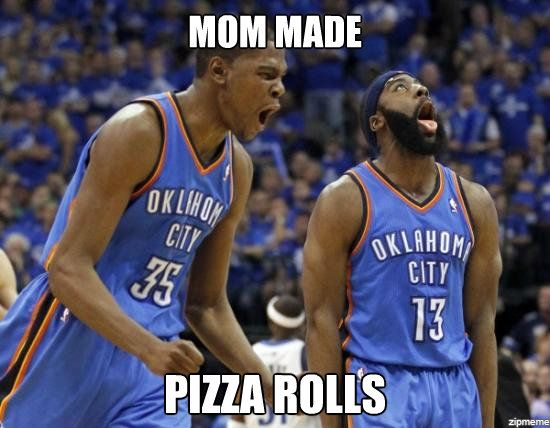
Pizza Rolls

The "pizza roll" memes are a perfectly example of generativity on the internet. The origins of the meme are based on the simple premise that the members of the Oklahoma City Thunder basketball team are mostly young players. There is no direct connection between the Thunder and pizza rolls other then the simple fact that the Thunder are a young team and pizza rolls are predominately marketed toward young children. An alternative interpretation of the meme is based on the notion that the team's star Kevin Durant is perceived as a "mama's boy" because she attends all of the Thunder's home games, thus some of the memes carry the caption "mom made pizza rolls". The concept has spread and mutated into memes using images from the Olympics, baseball, volleyball, the Jewish holocaust, as well as incorporating images of politicians Barack Obama, Herman Cain and Martin Luther King, and singer Katy Perry.