Showing posts with label richard dawkins. Show all posts

Tuesday, 11 September 2012

Longevity


Longevity is Dawkins' third major characteristic of a successful meme. The longer a meme remains viral, the more it can be replicated and spread onto new minds, ensuring its ongoing circulation. Longevity can only occur when ideal conditions for a meme's replication, innovation and evolution are in place. That is, circulation at an optimal time, such as coinciding with current events and spread within ideal affinity spaces, such as appropriate networks with relative opinions. A prime example of a long-surviving joke that has made its way into the digital world where it has become a fecund meme is what is known as the "Lebron ringless" meme. The memes of this joke can vary in terms of content but the main message of the joke remains constant, that is the theme of Lebron James's inability to win a NBA championship during the first 9 seasons of his career. Memes regarding the situation range from comparing him with other championship winning athletes, mobile phone ring tones and the Olympic logo. Since James has now won an NBA championship, the meme continues to live on, by comparing various cultural aspects of daily routines as having "more rings" then Lebron, for example, a phone usually rings more the once. The longevity of this particular Lebron James meme, among the many that is in circulation, is also due in large part to people connecting with the humour behind it, otherwise the meme would not be as long-lived as it has been. Indeed, some fans may claim that only a marquee player such as Lebron James could have generated such attention. However, what is perhaps most significant is that collectively, the Lebron James memes exhibit an aspect of fan culture that is diverse and yet complex, with an abundance of themes being contradictory to his star image.

Clearly, the memes' contradictions between James's pubic persona and marketing strategies and what a global fan base is thinking, hooked into a sizable and ultimately widespread discontent with James's personality. The Lebron James memes has proven to be robust and long-lived. A quick search on Google using terms like "Lebron James memes" or "Lebron ringless memes" brings up a plethora of links and images to websites that have reproduced different variations of meme concerning James, with many adding their own input and creations to the designs. The memes are infectious because of the absurd humour contained in the macro images, such as comparing James's lack of championships to the number rings that make up the Olympic logo. The humour within the exchange does not hide the notion of the high degree of generativity that exists within online sports fandom.


Thursday, 23 August 2012

Fecundity


Fecundity is Dawkins' second key feature of successful memes. Fecundity refers to the rate at which an idea or a trend is copied and spread. That is, the more quickly a meme spreads, the higher the possibility it will capture wider imaginations and sustained attention, and will be replicated, reproduced and distributed in the process (Knobel 2006, 412). A recent example of how the rapid spread of a meme can have on cultural trends in the world, is provided by the fan responses to Chicago Bulls bench warmer Brian Scalabrine. Fan-recorded videos of Scalabrine during Bulls games are posted throughout YouTube, in which the crowds unanimously cheer for him by chanting his name or the slogan "MVP". These positive crowd responses draw heavily on the host of Brian Scalabrine related memes that has flooded sports meme and basketball fan communities throughout the internet. The memes sarcastically praise his basketball skills and portray him as a marquee talent. The memes spread like wildfire throughout basketball fan networks, where it was copied, refined, combined and transmitted across the various meme communities on the internet. The sarcastic tone of the memes created humour, which in turn, created buzz for the theme, which ultimately lead to the success of the meme as it became "trendy" for online basketball fans to make Brian Scalabrine memes. The success of the meme has translated into the mainstream with fans offering him support that has traditionally been reserved for the superstars of the game. The other significant impact of the meme is that, those who are less familiar with basketball may possibly mistake Scalabrine to actually be one of the sport's major superstars. The exposure of Scalabrine through the fecundity of the meme effectively transformed his image to a career fringe player, to a cult hero.

Richard Brodie (1996) adds an important dimension to the analysis of memes. He argues that memes tend to influence minds more quickly when they are transmitted by "trustworthy others" (Brodie 1996, 152). The "trustworthy others" Brodie (1996, 152) refers to can include "people I would like to be like" or "people like me". So using the Scalabrine memes as an example, fans exposed to the memes were mostly already interested in basketball and memes, and because it became "cool" to create Scalabrine memes, many individuals wanted to follow the trend as well. Thus, affinity spaces and ideal conditions clearly play a role in the fecundity of a successful meme.

Scalabrine chants:

Scalabrine Memes:


Tuesday, 21 August 2012

Fidelity


As discussed in the preceding posts of this blog, Richard Dawkins (1976) theorised three characteristics of successful memes, all of which remain relevant today. Fidelity, fecundity, longevity refers to the meme's quality that enable easy imitation, replication and spreadability of the meme. Fragments of information that make sense or are meaningful to the reader are likely to become more successfully imitated or reproduced. In this sense, memes are successful because they are memorable (Blackmore 1998, p. 57). However, there is also an argument that they are important and useful as well, because of the increasing prominent use of memes as a communication method.

One important aspect of meme fidelity is susceptibility (Knobel 2006, 414). The notion of susceptibility refers to the timing or location of a meme, such as the meme's relevance to current affairs, its relation to already successful memes, as well as the interests and values of the space in which the meme is circulated. According to Knobel (2006), "ideal conditions" of susceptibility will allow particular memes to function more easily and maximize the possibilities for the meme to spread and go viral. Under ideal conditions, the "hooks" and "selection attractors" built into the design allows the meme a higher possibilities of success, without being hindered by community filters, audience confusion or other forms of cultural barriers.

For example, since Michael Jordan's retirement, contemporary mass media has consensually advertised, marketed and talked about him as being the greatest basketball player of all time. Certainly, his statistics and overall achievements in the sports reinforce this notion. These images firmly portray Jordan as an iconic hero, in highlight reels, graphic montages, magazine features and endorsement campaigns.

Since retiring as a player, Jordan has ventured into managerial roles within the NBA, first as the general manager of the Washington Wizards and more recently, as the owner of the Charlotte Bobcats. Both franchises have rarely experienced success under the management of Jordan, with the Bobcats accumulating the unenviable achievement of having the win/loss record in NBA history during the 2011-12 season.

Many fans begun to question Jordan's greatness and alternative memes began circulating throughout the meme and basketball fan communities of the internet. These memes challenge broadcasted versions of Jordan during his playing career, as well as his overall legacy. The memes mock his failures as a team administrator and frequently incorporates existing memes, in order to further the notion of familiarity. The memes spread rapidly via social networks and meme websites, hooking into the sarcastic tone of memetics and ongoing critiques of Jordan's (lack of) administrative skills, that begun originally emerged from within discussion forums and social media.


Official Jordan advertisements.


Memes


Tuesday, 7 August 2012

Fidelity, Fecundity and Longevity


In The Selfish Gene, Richard Dawkins (1979) identifies three characteristics of memes as: fidelity, fecundity and longevity. Despite his work being written in 1979 and focused on human interaction from a biological perspective, Dawkins’s ideas can be applied to measure the evolution of particular internet memes.

Fidelity refers to the recognisability of the meme. That is, while variations are vital aspects to the evolution of a meme, the core idea of the meme usually remains intact. The majority of memes rely on the recognisability of the image, video or caption and if audiences can not connect the resemblance of the meme and the source text, then the meme will likely be unsuccessful.

For example, the “bitch please” meme uses the face of former NBA star Yao Ming to convey a dismissive or sarcastic attitude to one's ideas or input. The image is easily recognised by basketball fans but those who are not familiar with the sport likely would not understand the humour of it.


Through spreadability on the internet, the image macro has since become popular on meme templates and used as a vehicle to convey messages beyond the sport of basketball.


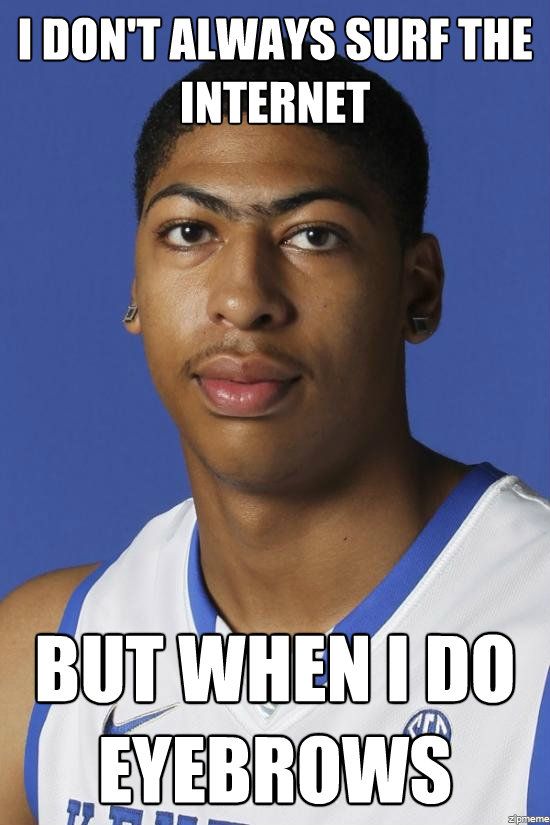
Fecundity refers to how rapidly a meme can be replicated and spread. Obviously, the more imitations that are spawned from a particular meme measures the success of the meme. When Anthony Davis was hyped as the future of basketball, images and videos of him in action saturated the online basketball fan community. However, fans quickly became more interested in his facial features rather then his basketball talents. Memes which made fun of his eyebrows and teeth began surfacing throughout the internet where thousands of replications have spawned as a result.


Longevity measures how long a particular meme can survive and evolve. For example memes concerning Lebron James's unsuccessful attempts at winning a NBA championship ring has been the topic of meme creations throughout his career. Now that he has won a NBA championship ring, memes regarding his inability to win more then one championship have become the norm.


The sharing of information on the internet promotes independence and autonomous creativity by lowering the barrier of entry for creative production where individuals are encouraged to participate in this cultural process and express themselves. Internet memes seem to tip-toe the very fine lines between creative innovation and tasteless kitsch, as well as profound wit and unsympathetic vulgarity. Regardless, whether users are producing successful memes or not, internet memes also have the power to significantly influence social beliefs, ideas, perceptions and values.

From an industrial standpoint, whether it is overwhelmingly supporting the underdog or profusely rejecting the superstar, internet memes through imitation, replication and spreadability, has the potential to build popular consensus that can translate into the real-world, creating a situation that goes against the commercial imperatives of sports advertisers and corporations.