Showing posts with label yao ming. Show all posts

Friday, 10 August 2012

Rage


Rage faces or rage comics are images created in Paintbrush that depict particular facial expressions. In general, Paintbrush edited images are considered to be amateurish compared to images crafted using professional editing software such as Photoshop. Thus, "rage" imagery is considered to be synonymous to amateurism in terms of visual aesthetics and its origins. The result is of course, is that it conveys the message that anyone is able to contribute to the community by easily creating memes. However, the popularity of rage expressions extends beyond its simplicity; original memes can develop into a number of metamemes. Each is represented by the core image as its central concept but portrays a different emotion of behaviour.

This comic originated on the 4chan forums as the "FFFUUUU rage guy" and as the name suggests, the image was mostly about circumstances that led to anger or frustration. While most "rage" faces are not used to express rage, the name has been used due to their rage guy origins. Among the most notable rage faces are: "Rage Guy", "Troll Face", "Forever Alone Guy" and "Y U No Guy". The concept begun to spread rapidly when Reddit launched a sub-platform allowing users to submit their own rage creations. As a result of its popularity, templates were developed allowing users to create memes featuring rage faces with better ease. These faces are not only characters and are also representations of emotional states, to portray particular messages. The significance of rage memes is that they are mostly utilised to talk about everyday issues as opposed to being generated as a result of movie premiers, historical sporting moments, international incidents, and so on.


The rage style has continued to evolve by incorporating well known cultural figures into the design scheme. To date, there have been several rage style memes using the faces of U.S president Barack Obama, actor Jackie Chan and basketball player Yao Ming.


Most of the stories portrayed in rage memes are everyday tales, so therefore it can be argued that they serve as a way to seek connection with others by talking about issues and situations concerning everyday life through memes. Compared to written texts, macro images adds the notion of visual interaction and  people are invited to co-create and to think about what message it is trying to convey. Although the specific example of a roughly sketched image might seem outlandish, rage comics and internet memes in general, as the online world’s cultural artefact helps to illuminate how people express values and share interests, which then leads to the enablement of critical judgment within web-memberships and in some cases, the creation of activism movements.


Tuesday, 7 August 2012

Fidelity, Fecundity and Longevity


In The Selfish Gene, Richard Dawkins (1979) identifies three characteristics of memes as: fidelity, fecundity and longevity. Despite his work being written in 1979 and focused on human interaction from a biological perspective, Dawkins’s ideas can be applied to measure the evolution of particular internet memes.

Fidelity refers to the recognisability of the meme. That is, while variations are vital aspects to the evolution of a meme, the core idea of the meme usually remains intact. The majority of memes rely on the recognisability of the image, video or caption and if audiences can not connect the resemblance of the meme and the source text, then the meme will likely be unsuccessful.

For example, the “bitch please” meme uses the face of former NBA star Yao Ming to convey a dismissive or sarcastic attitude to one's ideas or input. The image is easily recognised by basketball fans but those who are not familiar with the sport likely would not understand the humour of it.


Through spreadability on the internet, the image macro has since become popular on meme templates and used as a vehicle to convey messages beyond the sport of basketball.


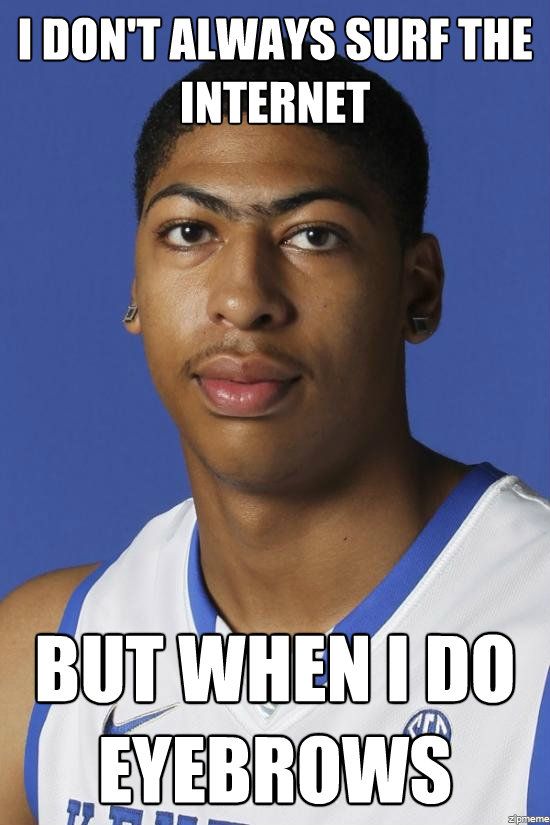
Fecundity refers to how rapidly a meme can be replicated and spread. Obviously, the more imitations that are spawned from a particular meme measures the success of the meme. When Anthony Davis was hyped as the future of basketball, images and videos of him in action saturated the online basketball fan community. However, fans quickly became more interested in his facial features rather then his basketball talents. Memes which made fun of his eyebrows and teeth began surfacing throughout the internet where thousands of replications have spawned as a result.


Longevity measures how long a particular meme can survive and evolve. For example memes concerning Lebron James's unsuccessful attempts at winning a NBA championship ring has been the topic of meme creations throughout his career. Now that he has won a NBA championship ring, memes regarding his inability to win more then one championship have become the norm.


The sharing of information on the internet promotes independence and autonomous creativity by lowering the barrier of entry for creative production where individuals are encouraged to participate in this cultural process and express themselves. Internet memes seem to tip-toe the very fine lines between creative innovation and tasteless kitsch, as well as profound wit and unsympathetic vulgarity. Regardless, whether users are producing successful memes or not, internet memes also have the power to significantly influence social beliefs, ideas, perceptions and values.

From an industrial standpoint, whether it is overwhelmingly supporting the underdog or profusely rejecting the superstar, internet memes through imitation, replication and spreadability, has the potential to build popular consensus that can translate into the real-world, creating a situation that goes against the commercial imperatives of sports advertisers and corporations.


Wednesday, 1 August 2012

Bitch Please!


The majority of memes are easily recognisable through its image or video and if one cannot instantly see the resemblance between the meme and its source text, then the meme will likely be less popular. For example, the Yao Ming face, also known as "Bitch Please", "Dumb Bitch" or "Fuck That Guy" is a rage comic-style drawing of former Houston Rockets star Yao Ming. The image is based on a photograph of Yao, from a press conference in May 2009. According to knowyourmemes.com, the comic drawing of the image first appeared on reddit.com in July 2010. The image has since been commonly used in meme templates and is typically used as a reaction face to depict sarcasm and the portrayal of a dismissive attitude towards a situation, input or opinion. Variations of the stock image include the "Fuck No Guy" which uses Yao's face, edited with a horrified expression.

This meme is particularly interesting because its source text, which is Yao's personality, he is considered to be shy, humble and sincere by most basketball fans. The meme's power relies precisely on the viewer's ability to register his personality traits to understand the sarcastic and satirical nature of the memes and to recognise the new environment into which Yao has been inserted and find humour in the incongruity of the situation.


Original source image:


Memes: