Showing posts with label anthony davis. Show all posts

Tuesday, 2 October 2012

3. Humour

Humour is the third element in Shifman's typology to analysing memes. She asserts that humour can provide unique insight into culture and believes it is a central element for successful memes. For the most part, humour is universal and can be observed within a vast host of societies and understood by individuals from many cultural backgrounds. Lankshear and Knobel break down the distinct patterns within memes that are considered to be key contributors to their fecundity. The prevalent theme is that there is always an element of humour, ranging from quirky parodies to the outright disgusting, through to the acerbically ironic. The element of humour is conveyed through intertexuality such as cross-references to different everyday or popular cultural events, icons or phenomena, or creative juxtapositions of images, video clips or music lyrics.

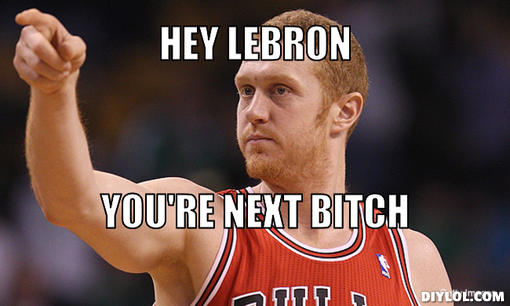
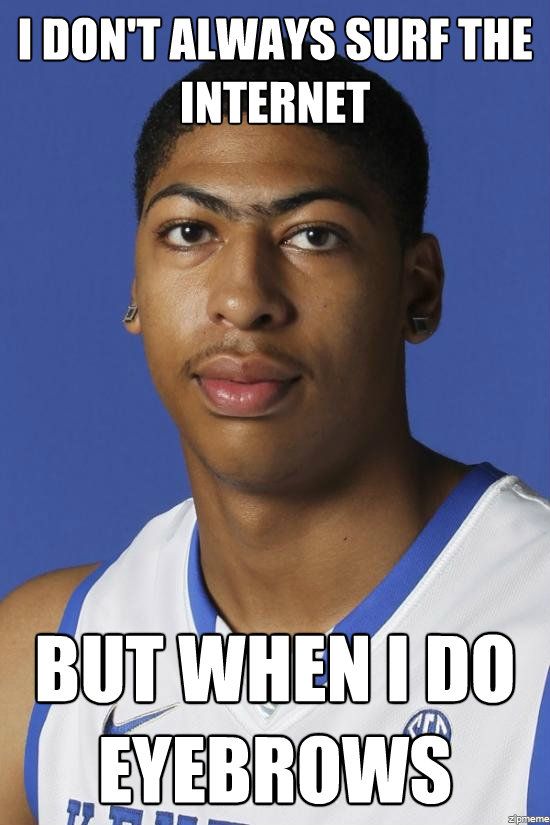
These ideas can also be applied to analysing basketball memes. The predominant structure of basketball memes is to attempt to share one's feelings through humour. As noted by Lankshear and Knobel, there can be various notions of humour, from sarcastic wit, to the outrageously bizarre or harmful personal attacks. In terms of basketball memes, these can from Brian Scalabrine's lack of playing time, Lebron James's receding hairline, Anthony Davis's uni-brow, Chris Bosh's facial features, the perceived compromising of fair play due to crooked referring or administrative decisions, and so on. 


Thursday, 9 August 2012

I thought dinosaurs were extinct?


From lolcats to rickrolling and from rage comics to memes, online gimmicks have become increasingly prominent in contemporary culture and with advances in digital media; websites such as knowyourmemes.com have become popular interactive communities for net users. Consequently, viral images in the form of memes have evolved into a genre with its own established culture and characteristics.

Clay Shirky (2010) argues that technology and the prominence of online communities enabled by convergent social media have led humanity into a golden era. The barriers between producer and audience have been drastically lowered and people are now capable of shifting from their traditional roles as passive consumers to active cultural producers (Shirky 2010, 18 - 20). Quality is essentially secondary because it is not created by professionals; therefore it is not expected to portray the aesthetics of a professionally produced work. Memes may appear to be silly on the surface but they are still creative and invoke thinking by people who access them and this can only be made possible by freely experimenting and sharing within online communities. Shirky further adds that, the new digital era will continue to evolve as more individuals realise they are no longer dictated to by cultural industries and can now congregate to use media tools in creating their own culture.

Furthermore, as a form of resistance against cultural industries, many memes attempt to twist the meanings of original works or professional crafted star images. One particular trait of this culture is that there appear to be no boundary when it comes to the creation of memes. While it is common for memes to mock the source texts, the straight forwardness of memes can be of vicious and vulgar nature. For instance, the Anthony Davis memes shared in the previous posts of this blog demonstrate that memes are seemingly created with a "no holds barred- everything-goes" mindset. A good majority of Anthony Davis related memes mocks his facial features. Memes related to multiple time NBA all-star and 2008 Olympic gold medallist Chris Bosh, appropriate the same tone.


This free production model enabled by convergence and anonymity has fostered many values such as increasing diversity, forming consensus, creating identity and expressing ideas. By no means, are memes considered high-end art but they are certainly becoming a staple in mass culture. As Shirky (2010) argues, in reference to 4chan, they are extremely protective of their rights to free speech and strongly promote information sharing and user anonymity.  While memes were first assembled as a celebration of internet culture, it has gradually become an influential form of expression due to the ability for users to mass create. The straight forwardness of the content, made by ordinary individuals perhaps can reveal traits of consumption and production within society itself, such as the relentless pursuit for instant entertainment, regardless of the potential ramifications that it may bring.


Shirky then concludes that though they first assembled
to celebrate their Internet culture, they then became more civically active because
of their ability to create (Shirky, TED). In 2008, users manifested 4chan’s political
aspirations into the democratic hacker-activist network, “Anonymous,” which takes
its name from the forum’s membership because it only wields its collective power
when there is majority consensus, similar to how a meme only gains strength through
numbers and connection. Although it has no sole leader and instead functions like
the hive mind in 4chan, it has protested against the Church of Scientology, supported
Wikileaks and its founder Julian Assange, and harshly criticized illegal online corporate
actions.

Tuesday, 7 August 2012

Fidelity, Fecundity and Longevity


In The Selfish Gene, Richard Dawkins (1979) identifies three characteristics of memes as: fidelity, fecundity and longevity. Despite his work being written in 1979 and focused on human interaction from a biological perspective, Dawkins’s ideas can be applied to measure the evolution of particular internet memes.

Fidelity refers to the recognisability of the meme. That is, while variations are vital aspects to the evolution of a meme, the core idea of the meme usually remains intact. The majority of memes rely on the recognisability of the image, video or caption and if audiences can not connect the resemblance of the meme and the source text, then the meme will likely be unsuccessful.

For example, the “bitch please” meme uses the face of former NBA star Yao Ming to convey a dismissive or sarcastic attitude to one's ideas or input. The image is easily recognised by basketball fans but those who are not familiar with the sport likely would not understand the humour of it.


Through spreadability on the internet, the image macro has since become popular on meme templates and used as a vehicle to convey messages beyond the sport of basketball.


Fecundity refers to how rapidly a meme can be replicated and spread. Obviously, the more imitations that are spawned from a particular meme measures the success of the meme. When Anthony Davis was hyped as the future of basketball, images and videos of him in action saturated the online basketball fan community. However, fans quickly became more interested in his facial features rather then his basketball talents. Memes which made fun of his eyebrows and teeth began surfacing throughout the internet where thousands of replications have spawned as a result.


Longevity measures how long a particular meme can survive and evolve. For example memes concerning Lebron James's unsuccessful attempts at winning a NBA championship ring has been the topic of meme creations throughout his career. Now that he has won a NBA championship ring, memes regarding his inability to win more then one championship have become the norm.


The sharing of information on the internet promotes independence and autonomous creativity by lowering the barrier of entry for creative production where individuals are encouraged to participate in this cultural process and express themselves. Internet memes seem to tip-toe the very fine lines between creative innovation and tasteless kitsch, as well as profound wit and unsympathetic vulgarity. Regardless, whether users are producing successful memes or not, internet memes also have the power to significantly influence social beliefs, ideas, perceptions and values.

From an industrial standpoint, whether it is overwhelmingly supporting the underdog or profusely rejecting the superstar, internet memes through imitation, replication and spreadability, has the potential to build popular consensus that can translate into the real-world, creating a situation that goes against the commercial imperatives of sports advertisers and corporations.