Showing posts with label participatory culture. Show all posts

Friday, 10 August 2012

Rage


Rage faces or rage comics are images created in Paintbrush that depict particular facial expressions. In general, Paintbrush edited images are considered to be amateurish compared to images crafted using professional editing software such as Photoshop. Thus, "rage" imagery is considered to be synonymous to amateurism in terms of visual aesthetics and its origins. The result is of course, is that it conveys the message that anyone is able to contribute to the community by easily creating memes. However, the popularity of rage expressions extends beyond its simplicity; original memes can develop into a number of metamemes. Each is represented by the core image as its central concept but portrays a different emotion of behaviour.

This comic originated on the 4chan forums as the "FFFUUUU rage guy" and as the name suggests, the image was mostly about circumstances that led to anger or frustration. While most "rage" faces are not used to express rage, the name has been used due to their rage guy origins. Among the most notable rage faces are: "Rage Guy", "Troll Face", "Forever Alone Guy" and "Y U No Guy". The concept begun to spread rapidly when Reddit launched a sub-platform allowing users to submit their own rage creations. As a result of its popularity, templates were developed allowing users to create memes featuring rage faces with better ease. These faces are not only characters and are also representations of emotional states, to portray particular messages. The significance of rage memes is that they are mostly utilised to talk about everyday issues as opposed to being generated as a result of movie premiers, historical sporting moments, international incidents, and so on.


The rage style has continued to evolve by incorporating well known cultural figures into the design scheme. To date, there have been several rage style memes using the faces of U.S president Barack Obama, actor Jackie Chan and basketball player Yao Ming.


Most of the stories portrayed in rage memes are everyday tales, so therefore it can be argued that they serve as a way to seek connection with others by talking about issues and situations concerning everyday life through memes. Compared to written texts, macro images adds the notion of visual interaction and  people are invited to co-create and to think about what message it is trying to convey. Although the specific example of a roughly sketched image might seem outlandish, rage comics and internet memes in general, as the online world’s cultural artefact helps to illuminate how people express values and share interests, which then leads to the enablement of critical judgment within web-memberships and in some cases, the creation of activism movements.


Wednesday, 8 August 2012

"Meme warfare" - Jason Kidd- All time great or All time drunk?


In his journal article regarding online activism, Dennis Allen (2003) talks about a "meme warfare" in which users, through memes attempt to counter commercial images and ideas. The "metameme" as described by Allen works to reposition the perception of the corporate world and sparks a larger critique of corporate culture. For instance, current affairs or events can incite the creation of an internet meme, which in turn forms conversation for those who access and share it. Movies or television shows for example, often invoke conversations between people and many of them are expressing themselves through memetic activity. Using the movie franchise Twilight as an example, the release of the movies has prompted a host of internet memes which predominately mocks everything that is associated with the films such as the storyline, characters and its fans. A popular template for Twilight memes features the caption "Still a better love then Twilight".


The meme mocks the storyline of the movies and at the same time promotes resistance against the commercial strategies of media producers.


Similar trends is also evident in the world of basketball in which fans are spawning memes in real-time fashion , prompted by match or player incidents. These affairs can vary from the most shocking to the most comical and often the messages conveyed through memes goes against a player's star image or the sport's commercial strategies. A prime example of this are memes concerning Kobe Bryant and Lebron James where much of the messages in the memes portray them as selfish individuals, rather then great players of the game, or memes regarding Brian Scalabrine that portray him as a great basketball talent, who in the real-world is a fringe player, at best.

Another example, New York Knicks point guard Jason Kidd was arrested on drink-driving charges after crashing his vehicle. Kidd, who is considered as one of the greatest players of the modern era, for his selfless style of play, is highly respected among the basketball community. Fans and pundits alike widely perceive him as a role model who upholds all the mythical ideologies associated with sports such as fair play and sportsmanship. Media exposure ensured that many basketball fans quickly became familiar with reports of Kidd's arrest. Kidd's image rapidly became a symbol for fans to mock. In short amount of time, there have been many variations of the meme, where people expressed their opinions about the incident. Whether or not the meme becomes successful is essentially secondary when it comes to measuring the cultural influence of memes. The immediacy of convergent media allow fans to circulate their thoughts as soon as stories are reported and their memetic expressions can spread rapidly via social networks, allowing consensus to be formed which are at times contradictory to the visions of media officials. For instance, the Jason Kidd memes posted in this blog has spread throughout the internet where it has the potential to challenge his heroic star image, which can lead to further ramifications such as tarnishing the commercial image of the player, the team, the league and possibly the sport in general.


Most likely, these Jason Kidd memes will remain within the spheres of basketball fan communities, but the significant point is that, fans were willing to invest their time and effort to craft memes about the incident, further demonstrating the cultural phenomenon of memes, as a creative and yet powerful way of expression.


Tuesday, 7 August 2012

Fidelity, Fecundity and Longevity


In The Selfish Gene, Richard Dawkins (1979) identifies three characteristics of memes as: fidelity, fecundity and longevity. Despite his work being written in 1979 and focused on human interaction from a biological perspective, Dawkins’s ideas can be applied to measure the evolution of particular internet memes.

Fidelity refers to the recognisability of the meme. That is, while variations are vital aspects to the evolution of a meme, the core idea of the meme usually remains intact. The majority of memes rely on the recognisability of the image, video or caption and if audiences can not connect the resemblance of the meme and the source text, then the meme will likely be unsuccessful.

For example, the “bitch please” meme uses the face of former NBA star Yao Ming to convey a dismissive or sarcastic attitude to one's ideas or input. The image is easily recognised by basketball fans but those who are not familiar with the sport likely would not understand the humour of it.


Through spreadability on the internet, the image macro has since become popular on meme templates and used as a vehicle to convey messages beyond the sport of basketball.


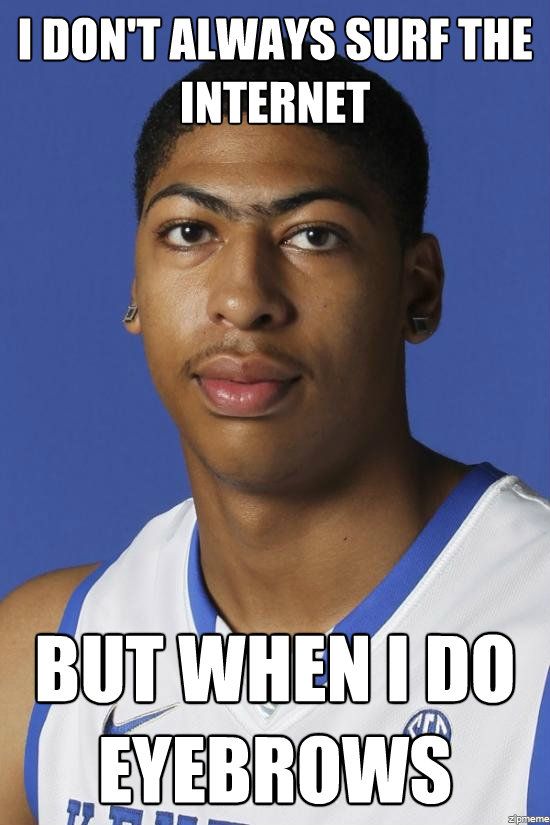
Fecundity refers to how rapidly a meme can be replicated and spread. Obviously, the more imitations that are spawned from a particular meme measures the success of the meme. When Anthony Davis was hyped as the future of basketball, images and videos of him in action saturated the online basketball fan community. However, fans quickly became more interested in his facial features rather then his basketball talents. Memes which made fun of his eyebrows and teeth began surfacing throughout the internet where thousands of replications have spawned as a result.


Longevity measures how long a particular meme can survive and evolve. For example memes concerning Lebron James's unsuccessful attempts at winning a NBA championship ring has been the topic of meme creations throughout his career. Now that he has won a NBA championship ring, memes regarding his inability to win more then one championship have become the norm.


The sharing of information on the internet promotes independence and autonomous creativity by lowering the barrier of entry for creative production where individuals are encouraged to participate in this cultural process and express themselves. Internet memes seem to tip-toe the very fine lines between creative innovation and tasteless kitsch, as well as profound wit and unsympathetic vulgarity. Regardless, whether users are producing successful memes or not, internet memes also have the power to significantly influence social beliefs, ideas, perceptions and values.

From an industrial standpoint, whether it is overwhelmingly supporting the underdog or profusely rejecting the superstar, internet memes through imitation, replication and spreadability, has the potential to build popular consensus that can translate into the real-world, creating a situation that goes against the commercial imperatives of sports advertisers and corporations.


Friday, 3 August 2012

More Lebron's fault, Olympic memes


The invitation to remix is reminiscent of classical forms of story telling. For example, music is one form of source text that is continually reinvented through covers, parodies and remixes. Like songs, memes gained popularity due to their open invitation to participate, consuming, collecting, remixing and sharing. Using "lolcats" as an example, it is formed simplistically with minimal creativity and according to Clay Shirky (2010, 18), "the average lolcat image has the social value of a whoopee cushion and the cultural life span of a mayfly...yet anyone seeing a lolcat gets a second related message: You can play this game too". That is, while on the surface, memes may appear to have little cultural value but the more significant message of participation allows the prospect of mutation which in turn creates the potential for these macro images to become carriers for different ideas (Burgess 2008, 108). The cultural relevancy and value of memes stand for many of the characteristics of cyberculture today, of collaboration and participation, enticing user-created content and networking, but they also ignite the creativity of a number of ideas that, along with generic meanings, still convey messages related to: race, gender, class, belief, politics and so on. The meme narrative is short and comprehensive and yet, a caption, an image or a video can speak a thousand words. Whether it is cats, Bad Luck Brian, Scumbag Steve, Rick Astley, Willy Wonka, Lebron James, Kobe, Bryant, Yao Ming and a global event like the Olympics or the soccer world cup, individuals are defining themselves by using these iconic voices to do their talking. Social networks are feeding this trend perfectly, net-users continuously scroll through comment spaces to find the best remarks, images or videos and more often then not, this is shared with someone.

The Lebron's Fault memes below demonstrate Shirky's logic in that, the cultural relevance of memes extends beyond what appears on the surface, while the values primarily lie within the genre, there can be other significant messages attached to it. As touched on in the previous post, "Lebron's fault" stemmed from comments made by Lebron James during a press conference, where he told reporters he felt he was unfairly scrutinised by the media and fans for issues he should not be held accountable for. 6 months on, the ESPN article that reported the story is still active with fan responses (over 5000 of them) mocking James's comments, blaming him for personal problems, issues within the sport and real world problems- http://espn.go.com/nba/conversations/_/id/7556817/miami-heat-lebron-james-apologize-kendrick-perkins-tired-blame-game


Similarly, the Olympics have triggered a host of memes concerning issues ranging from mocking certain situations such as the domination of the U.S men's basketball team to real world circumstances such as, British colonialism, drugs, politics, world hunger, race, egalitarianism (or the lack of) and obesity.