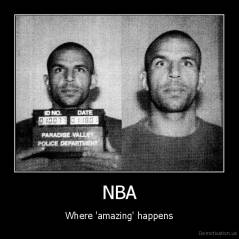
From 2007 - 2009 the NBA ran a series of advertisements featuring still images set to Carly Comando's song "Everyday" or Kanye West's "Amazing" with the catch phrase "Where Amazing Happens". Since then the ads have become popular with fans during the NBA season and on the internet with people parodying them. Earlier incarnations of this meme made fun of the league's crooked referees, ballooned salaries and player off-court discretions. While some memes are global, others are more culture specific, shaping collective actions and mindsets (Knobel and Lankshear, 2007). Later imitations of this meme including blending the theme to other sports, social activities (e.g video games) as well as showcasing what is amazing in one's own life, whether it is serious or comical.
Much like the popular "Hitler meme", where video clips of Hitler from the 2004 German film "Downfall" are used to spawn a wave of memes juxtaposing Hitler's rage with a stream of contemporary issues, the comic device for "Where Amazing Happens" is simple: new captions, images or footage are inserted with the image of the NBA logo and the phrase "Where Amazing Happens" or in the case of a video, the montage is set to the tune of "Everyday".
The series of "Where Amazing Happens" spoofs illustrates the fundamental attribute of contemporary popular culture, such as the representation system of simulacra and pastiche (Jameson 1991) in which core images such as a catch phrase, song, video clip or a photograph is replicated repeatedly. Additionally, the constant re-assembling of texts manifesting in new forms of expression, problem solving, circulation and affiliation by individuals reflect what Jenkins (2007) conceptualises as participatory culture. Fundamental to participatory culture is reworking content and sharing it in mash-ups, remixes, parodies among other actions of expression.
As mentioned in previous postings, the "most viewed" category on meme and video sharing sites is a key indicator of popularity of one's work. However, they also serve as key indicators to not only how many people viewed a meme or video but also how many individuals chose to do something with it (Burgess and Green 2009). This distinction is crucial as it epitomises the difference between the way mass media has traditionally been studied and how media can be evaluated in the digital environment where user participation is emphasised. For instance, the "Where Amazing Happens" memes originated back to a 2007 article written by Bill Simmons on espn.com in which he described a conversation with his friend about how to make a parody of the ad, Simmons shared his step-by-step ideas with his readers and since then his notes have been used as a template for parodies of the ad. These user created texts, whether it is a video or a graphic are simple in format and tend to lack the aesthetics of a professional production. Simmons' criteria is as follows-
"Where crooked referees happen."
"Where stealing money happens."
"Where paying spectators getting punched happens."
"Where a truck party happens."
Where white guys who think they're black happens."
"Where referees deciding a championship happens."
"Where quitting on your team happens."
"Where Amazing Happens."
In this sense, it may be argued that "amateur" texts translate into "good" memes (Shifman 2011). For instance, the "Where Amazing Happens" creations tend to have common features such as — focus on ordinary individuals, one's or someone else's personal shortcomings, humour, simplicity and repetitiveness. This is a distinct contrast and perhaps defiant to carefully crafted corporate content (Shifman 2011). This notion coincides with Jenkins (2009) argument that textual gaps enhance the "spreadability" of content. He argues that since the contemporary media environment heavily encourages user-involvement, the incompleteness and "amateurishness" of texts entices users into further dialogue such as fill in the gaps, address the creations or disagree with the creators, thus contributing to the spread of the meme.
Original videos
Parodies (Bill Simmons template)
Video titled "Bill Simmons Omissions" focusing on aspects of the game Simmons did not touch upon in his template.
Other fan parodies & imitations
Graphic memes




.png)
.png)
.png)