Showing posts with label memes. Show all posts

Friday, 27 July 2012

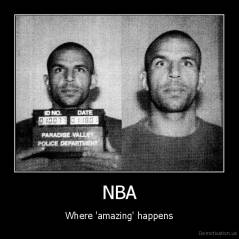
NBA- Where amazing happens


From 2007 - 2009 the NBA ran a series of advertisements featuring still images set to Carly Comando's song "Everyday" or Kanye West's "Amazing" with the catch phrase "Where Amazing Happens". Since then the ads have become popular with fans during the NBA season and on the internet with people parodying them. Earlier incarnations of this meme made fun of the league's crooked referees, ballooned salaries and player off-court discretions. While some memes are global, others are more culture specific, shaping collective actions and mindsets (Knobel and Lankshear, 2007). Later imitations of this meme including blending the theme to other sports, social activities (e.g video games) as well as showcasing what is amazing in one's own life, whether it is serious or comical.

Much like the popular "Hitler meme", where video clips of Hitler from the 2004 German film "Downfall" are used to spawn a wave of memes juxtaposing Hitler's rage with a stream of contemporary issues, the comic device for "Where Amazing Happens" is simple: new captions, images or footage are inserted with the image of the NBA logo and the phrase "Where Amazing Happens" or in the case of a video, the montage is set to the tune of "Everyday".

The series of "Where Amazing Happens" spoofs illustrates the fundamental attribute of contemporary popular culture, such as the representation system of simulacra and pastiche (Jameson 1991) in which core images such as a catch phrase, song, video clip or a photograph is replicated repeatedly. Additionally, the constant re-assembling of texts manifesting in new forms of expression, problem solving, circulation and affiliation by individuals reflect what Jenkins (2007) conceptualises as participatory culture. Fundamental to participatory culture is reworking content and sharing it in mash-ups, remixes, parodies among other actions of expression.

As mentioned in previous postings, the "most viewed" category on meme and video sharing sites is a key indicator of popularity of one's work. However, they also serve as key indicators to not only how many people viewed a meme or video but also how many individuals chose to do something with it (Burgess and Green 2009). This distinction is crucial as it epitomises the difference between the way mass media has traditionally been studied and how media can be evaluated in the digital environment where user participation is emphasised. For instance, the "Where Amazing Happens" memes originated back to a 2007 article written by Bill Simmons on espn.com in which he described a conversation with his friend about how to make a parody of the ad, Simmons shared his step-by-step ideas with his readers and since then his notes have been used as a template for parodies of the ad. These user created texts, whether it is a video or a graphic are simple in format and tend to lack the aesthetics of a professional production. Simmons' criteria is as follows-

"Where crooked referees happen."
"Where stealing money happens."
"Where paying spectators getting punched happens."
"Where a truck party happens."
Where white guys who think they're black happens."
"Where referees deciding a championship happens."
"Where quitting on your team happens."
"Where Amazing Happens."

In this sense, it may be argued that "amateur" texts translate into "good" memes (Shifman 2011). For instance, the "Where Amazing Happens" creations tend to have common features such as — focus on ordinary individuals, one's or someone else's personal shortcomings, humour, simplicity and repetitiveness. This is a distinct contrast and perhaps defiant to carefully crafted corporate content (Shifman 2011). This notion coincides with Jenkins (2009) argument that textual gaps enhance the "spreadability" of content. He argues that since the contemporary media environment heavily encourages user-involvement, the incompleteness and "amateurishness" of texts entices users into further dialogue such as fill in the gaps, address the creations or disagree with the creators, thus contributing to the spread of the meme.

Original videos

Parodies (Bill Simmons template)


Video titled "Bill Simmons Omissions" focusing on aspects of the game Simmons did not touch upon in his template.


Other fan parodies & imitations


Graphic memes


Thursday, 26 July 2012

Memes and viral videos


Like the meme community, the activities of online video-sharing communities like YouTube blur the distinction between producer and audience. Similar to quickmemes and knowyourmemes, YouTube use a rating system (like or dislike) to guide visitors towards popular videos. Culturally significant videos will also rise above others based on the number of views. Burgess (2008, 101) writes that internet memes in contemporary culture is a "faddish joke or practice" that becomes widely imitated and reproduced. When a video is spread, replicated and mutated "virally", its reproducibility seems to guide its cultural value. That is, a work’s reception has become a part of its reproducibility. In this understanding, like memes, viral videos online are spread and mutated via distribution networks in ways that media producers cannot control. Speaking on the cultural relevance of memes, Lolcat creator Ben Huh (2010) believes memes are "more relevant than most of what’s on television...just as the sitcom or the 30-minute news broadcast or the soap opera from radio were the hallmark of how a certain generation understood entertainment and culture". For instance, the "Hitler reacts" videos or "the Hitler meme", involves a dramatic scene from the 2004 film "Downfall" in which Hitler realises his imminent defeat during World War II and begins screaming at his subordinates. The film is in German and the videos are remixed so that instead of the fall of the Third Reich, Hitler is reacting angrily to matters like the weak real estate market or the vuvuzela controversy from the football World Cup. Individually, these videos has little influence but collectively, in their thousands and their millions of viewers, these videos signify the variety and versatility in how people express themselves in the digital world. 

Basketball videos are remixed with a similar approach, to convey personal opinions and ideas. For example, in recent years, there has been a popular trend for basketball fans to remix video clips from two particular Nike advertisements: "Rise" featuring Michael Jordan and "What Should I Do" featuring Lebron James. The original ads document Jordan and James' dedication to becoming elite athletes. Fan mash-ups of the advertisements have been reproduced to "Michael Jordan responds to Lebron" and "Kobe Bryant responds to Lebron James" which conveys the perception of Jordan and Bryant as superior athletes citing James's fragility under big match situations. Remixes have also included "Lebron James- What should I do" which is a spoof video of the ad, made by disgruntled Cleveland Cavaliers fans, the team James left to join the Miami Heat. The same ads have also been remixed with gameplay from video games such as NBA2K and Call of Duty, and comically parodied with other sports television personalities to athletes from the NFL and UFC. 

Like memes, the "How quickly they forget" videos maintain a core framework of the video title and the song "Serenata Immortale" as the theme. The videos compare the on-court accomplishments of Michael Jordan with contemporary stars such as Kobe Bryant and Lebron James. 

The dynamics of memes and viral videos can be understood as involving the spread of replicable ideas through the processes of creativity, among individuals and communities connected by social networks (Burgess 2008, 110). Much academic focus is directed at the boundaries between old and new mass-media and the more egalitarian tone that is taking shape online. The notion of advocating for certain beliefs that go against the commercial grain of media producers or converting one's misfortunes into hilarious entertainment for millions of viewers can be as equally important in revealing a truth about the emerging trends in a digital age where the producers and administrators alike do not have full control. In some cases, expressions conveyed through memes or viral videos extend beyond the pleasure of laughter but satirical, sarcastic, expression, intentional or otherwise also jolts the viewer to confront other questions like, "what am I looking at?", "what am I laughing at?" or "do I agree with this message?" According to Walker (2010) in his New York Times article concerning the cultural influence of memes, he writes "This is what egalitarian cultural production really looks like, this is what having unbounded spaces really entails, this is what anybody-can-be-famous means...the real point is that to pretend otherwise isn’t denying the Internet — it’s denying reality". 

Original ads

Fan remixes