Showing posts with label fan activism. Show all posts

Tuesday, 24 July 2012

Expressions of fan displeasure through memes- David Stern


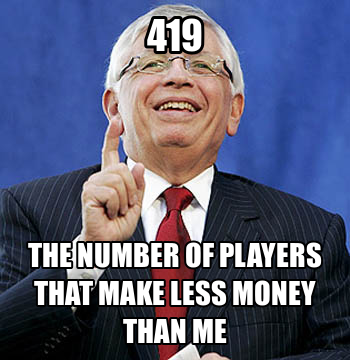
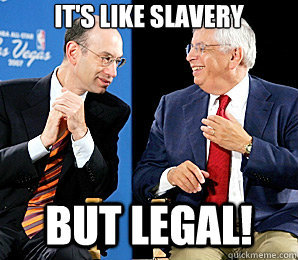
National Basketball Association (NBA) fans has often blamed executive decisions made by league commissioner David Stern, as the main catalyst for compromising the ideals of competition and fair play in the NBA. Such accusations include, draft rigging to suit teams with larger television markets, allowing player transactions to favour major city teams and refusing to compromise during negotiations talks by the players union for an increased salary, ultimately leading to the 2011 - 2012 NBA season lockout, cutting the season short by 16 games. More recently, Stern was accused of vetoing the trade of marquee of players and rigging the 2012 NBA draft to allow New Orleans Hornets to draw the top pick (the Hornets are owned by the NBA). Certainly, the proposition of fan displeasure towards Stern is supported by substantial levels of fan complaints regarding his decisions, across the various forms of fan generativity on the internet. Fan concerns are voiced out within message forums and more recently are expressed through memes. As proposed in a case study concerning football fans, written by David Rowe, Andy Ruddock and Brett Hutchins (2010) — they suggest that, a common and pleasurable way for fans to deal with what they perceive as 'unfavourable' basketball incidents is to complain. Complaints can take many forms. Perhaps the most familiar is to express discontent at the state of the sport due to the primacy of money and the power of media broadcasters and so on. Rowe, Ruddock and Hutchins (2010) also argue that complaints can be interpreted as a form of fan enthusiasm in the sense that, complaints actually exhibit fans' devotion to the sport, so much so, they are willing to invest their time and effort to express their feelings and build consensus among other fans, as to what they are unhappy about and crucially what they are willing to do about the situation. Using the observations from Rowe, Ruddock and Hutchins’ case study about football fans, there appear to be similarities in the way basketball fans embrace networked media for comment and activism. The memes below exhibit a degree of fan resistance towards the commercial imperatives of the NBA through memes, some of which are attempts of humour through sarcasm while others take on a more serious tone with personal attacks directed at NBA commissioner David Stern. Together, these memes comprise a consensual tone of basketball fans in that they see Stern's ambitions for increased revenue and television ratings as the major contributor to what they perceive as problems concerning the NBA.

Additionally, fans have also associated their displeasure with Stern, with cultural and political issues within society such as healthcare reforms in the United States, the world's aids epidemic and political tensions in the middle east.



Thursday, 19 July 2012

Fan activism through memes- Jeremy Lin


Fan activism has long existed on the internet, with fans bounding together to save television shows from cancellation, defend themselves from copyright infringement threats by media corporations and promote alternative ideas (Jenkins 2012). In Jenkins' article regarding fan activism through the Harry Potter Alliance (HPA), he concluded, the fan group encourages people to speak out as fans on a broad range of socio-cultural and socio-political issues, through what the group's leader, calls "cultural acupuncture". The group's generative practices of deploying content from the fictional universe onto real-world concerns helps empower fans to become civically engaged and politically active. Fan activism is also evident in an online capacity with similarly profound effects. For example, 4Chan, originally a manga and anime fandom community generated memes and spread them across the Internet. Among the creations was the Obama 'Joker' imagery that was used in the Tea Party's campaign's against 'Obamacare'.

Jeremy Lin's performances on the basketball court during the 2011-2012 NBA season captured the imagination of fan's worldwide. Lin became the first ever American of Taiwanese of Chinese descent and the first Harvard graduate in nearly 50 years to play in the NBA, and, unexpectedly led his team; the New York Knicks to a winning streak, helping them make the playoffs. His on-court success generated the global following known as 'Linsanity', where fans attach his surname to coin popular catchphrases such as 'Lincredible' instead of incredible, 'Linning' instead of winning, "Super Lintendo" instead of Super Nintendo, 'Linvestment' instead of investment. The internet derived term, 'Linsanity' has also translated into marketing success for Lin with brands such as Nike, New Era, Adidas, Ben & Jerry's and Volvo using the phrase to promote their products.


Kobe Bryant- Black Mamba or Ball Hog?


The meme is an evolutionary replicator, defined as unit of information (a catchphrase, a concept, an expression of fashion, philosophy, culture, or politics) that is copied from person-to-person by imitation. W. J. T. Mitchell poses the question ‘What do pictures want?’, implying that pictures may have an independent life- drawing on the rhetorical argument that the life-like properties of pictures affect people in different ways. This argument is mirrored in the creation of internet memes whereby individual pictures can be used to generate a host of varying interpretations. Concurrently, popular consensus can be conveyed through various different pictures. Fan-created memes can be used to convey messages advocating socio-cultural and socio-political beliefs, stereotypes and personal interpretations; conversely they can also serve as "creative vandalism" to subvert the official's representations of whatever issues they choose. For instance, memes concerning Kobe Bryant predominately stereotypes him as a "ball hog" due to his playing style, which relies heavily on shooting the basketball rather then distributing it to other team mates. This goes against the ideals of team-play that has traditionally been associated with team sports like basketball. This perception also challenges Bryant's star image as a global superstar and as one of history's greatest basketball athletes, whose accomplishments arguably rivals that of all-time greats like Michael Jordan. Many fans also cite Jordan’s selfless nature as a key reason in his superiority over Bryant.